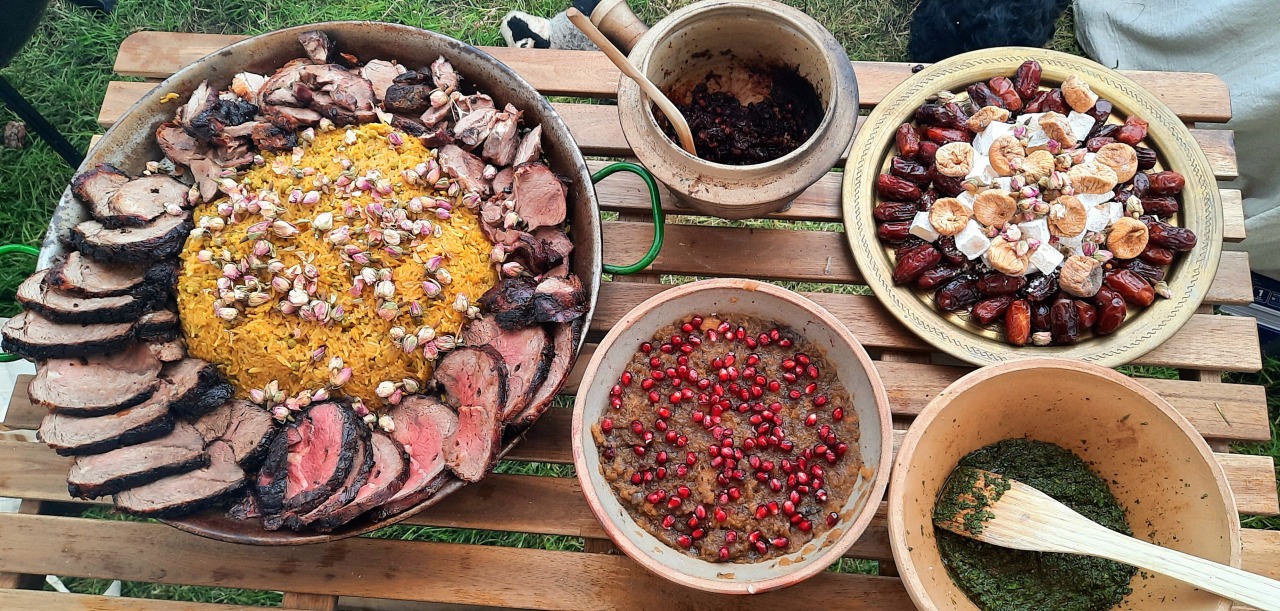
I’ve done a lot of work cooking Arabic food, and had to do very little research to get there, because Nawal Nasrallah has done an incredible amount in translating medieval Arabic cookery books. Two of these are Annals of the Caliphs’ Kitchens, which is a translation of a 10th century Baghdadi cookbook compiled by Ibn Sayyār al-Warrāq, and Treasure Trove of Benefits and Variety at the Table, a translation of the Kanz al-fawāʾid fī tanwīʿ al-mawāʾid, a 14th century Egyptian work. They’re usually referred to as “al-Warraq” and “the Kanz”.
These two books form the clearest example I can think of that medieval cultures are not monoliths. These are both Arabic works. They’re separated by three centuries and about 1300 kilometres (reckoning from Baghdad to Cairo), which within the scope of the medieval Arabic world is really not a long time or a long way.
There are dishes in common between the two books, although they’re not necessarily easy to spot. But there’s one enormous difference, which is the overall flavour profile. The dishes in al-Warraq are almost all savoury, and many of them use rue, a bitter herb not much used – really, not used at all – in modern cookery. Overall, there’s a tendency toward sourness and bitterness that’s difficult for the modern palate. And then in the Kanz, you get the use of sugar. So much sugar. This is Recipe 76, for ward murabbā (chicken with rose-petal jam):
You need ½ raṭl (½ pound) sugar syrup (jullāb), ½ raṭl rose-petal jam, and ½ raṭl bee honey. [Mix them] Boil the chicken and fry it, and then pour the ḥawāʾij (i.e., the above-mentioned ingredients) all over the chicken. Do this when the chicken is still in the pot, or in a vessel.
Sugar syrup like this is absolutely throughout the book. In comparison, there are a total of three mentions of it in al-Warraq.
One of the dishes that’s – more or less – in common between the two books is zīrbāj, described in the Kanz as “delicately sour golden stew”, and sikbāj, “beef stews soured with vinegar”, in al-Warraq. The Kanz recipe calls for a quarter of the meat’s weight in sugar, and notes that “For those who prefer the dish to be noticeably sweet, let them add more sugar, which can be replaced with honey.” The sourness in this dish comes from wine vinegar, which is added “as needed”.
In comparison, the recipe in al-Warraq uses “sweet vinegar” to “drench” the meat in an early stage, and then, later, “enough undiluted vinegar to submerge it and top it by four fingers width”. It does call for sweetness, though: “add to the pot bees’ honey or sugar syrup, the amount of which should be a quarter of the amount of vinegar used.” And it concedes, “You may add more syrup if the vinegar is exceptionally sour.”
I made the dish from al-Warraq, and went a lot easier on the vinegar than was described; I still couldn’t eat it. I should perhaps try the version from the Kanz, although I suspect that it’s going to go the other way, and be inadvisable for my diabetic self to eat at all.
I’m working on a reconstruction of Irish food, before the Norman conquest. It’s a smaller geographical area than the medieval Arabic world, but a longer time (between 600 and 800 years, depending on where you mark the start of “Irish”), so I can only assume that it too has the potential for a very great deal of variation.

Leave a Reply