Sonnets are my poetic form of choice, but I usually write them as modern poetry, rather than medieval. They are a medieval form, though, or at least within SCA period, having been popularised in Italy by Petrarch, and in England by Shakespeare and other writers of his era.
In this post I’m going to present a sonnet as I wrote it, and then make it more period-appropriate. This is not an approach I favour with food, my other art, and indeed, “how can I make X modern dish period-appropriate?” is a question designed to make me grind my teeth. But in this case, I feel that starting with the text as it comes to you is the only way to do it. I can write poetry from the ground up as medieval, in terms of word choice and grammar and so on, but that distracts so much from the poem itself that the end result is a technically-correct, technically-plausibly-period piece with no soul.
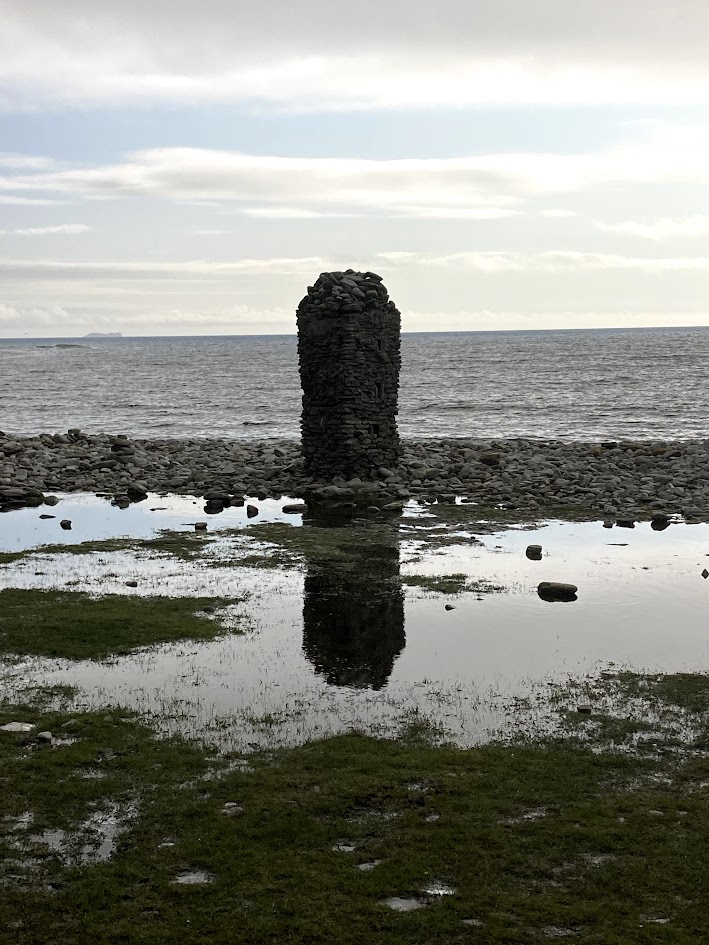
So here’s the sonnet as it came to me at about two in the morning a few nights after Strawberry Raid V.
As the Sea Opposes Building
Atlantic-child, you Celtic Sea, you moil
And churn, hissing, throwing stone against stone
In longshore drift, and grind pebbles alone
And together into sand, and you toil
To reach inland, and topple key from arch,
And bring low the tower. But your own work
Piles up against you, dune by dune, the dark
Wood drifted on the light sand. Your long march
Grows longer; you step back and back. You growl
In storm, and sigh in summer calm, and try
To reach us where we stand. But forlorn cry;
You’ve stopped bay to lake, and your wine-dark scowl
Looks on new shores. Ease now. Send wind instead;
It will fell stone from stone, the mortar bled.
The very first thing we can do is change the second-person pronoun, you, to the archaic thou. In Shakespeare’s time, this gave a more intimate tone; “you” was for more formal conversation. So:
Atlantic-child, thou Celtic Sea, thou moilst
… and since we’re not changing the number of syllables, it works fine. “Moilst” is a bit of an encumbrance of a word, but it’s legitimate, and definitely not modern. We’ll have to change line 4’s end-word to keep the rhyme, but usefully, it’s also a verb, and therefore “thou toilst” will work perfectly well. Likewise, we need to change “your own work” to “thine own work”; “Your long march” to “thy long march”, “you step back” to “thou stepst back”; and “You growl” to “Thou growlst”. “You’ve” becomes, “Thou’st” (thou hast), and “your wine-dark” becomes “thy wine-dark”. Strictly speaking, “try” should also change, but it’s far enough from the pronoun that I’m happy to leave it, and keep the rhyme with “cry”.
This leaves one issue; “growlst” no longer rhymes fully with “scowl”. So instead, let’s try “Thy growl / In storm, and sighs in summer calm, they try” – changing the growling and sighing from verbs to possessions of the sea. This, one could argue, increases the personification of the sea, which does no harm to the poem.
Next, a quick run through to make sure there are no modern references. I’ve caught things like “a cast of thousands” in poems before, a phrase that didn’t exist until the existence of movie posters in Hollywood.
“Atlantic” as a term goes back to a Greek word in the 6th century BCE, that’s fine. “Celtic Sea” can be traced exactly back as far as 1921, but as that’s what the poem directly addresses (in apostrophe, perhaps), I’m going to claim that that’s a name and leave it be. “Longshore drift” is a modern term too, from 20th century geologists, and while it sounds suitably archaic, I’m not happy with it. However, we can reverse it to “shore-long drift”, and have it pass much better, and still retain the implication for the modern reader.
“You’ve stopped bay to lake” sounds like a modern understanding of the process of sand deposition and brackish lake formation, but this has been pretty well understood for a very long time. The Ancient Egyptians knew perfectly well how the Nile deposited sand and the Mediterranean currents moved it, and the people of the Low Countries have been dealing with shifting sands for as long as there have been people there. The folk in now-submerged Doggerland probably had it too.
And finally, “wine-dark” is a direct reference to Homer, a writer well-known in the Medieval and Renaissance periods, and thereby an entirely appropriate inclusion.
The last step in this is to check if all the words existed in period. My shortcut on this is to load up a text file of the Complete Works of Shakespeare, and search through for each word. If I don’t find it, I can poke some histories and etymologies and look for the first occurrence. However, every word in this sonnet is verifiably pre-1600, so we’ve nothing to change there. So here’s the new version:
As the Sea Opposes Building
Atlantic-child, thou Celtic Sea, thou moilst
And churnst, hissing, throwing stone against stone
In shore-long drift, and grind pebbles alone
And together into sand, and thou toilst
To reach inland, and topple key from arch,
And bring low the tower. But thine own work
Piles up against thee, dune by dune, the dark
Wood drifted on the light sand. Thy long march
Grows longer; thou stepst back and back. Thy growl
In storm, and sighs in summer calm, they try
To reach us where we stand. But forlorn cry;
Thou’st stopped bay to lake, and thy wine-dark scowl
Looks on new shores. Ease now. Send wind instead;
It will fell stone from stone, the mortar bled.
